
October 2026 Newsletter - B12d Support Group :
Oct 30, 2026 · @Hugo Minney
Our next talk: Dr Asim Naqvi, Monday 9 November, 7pm GMT
Monday 9 November 2026, 7pm UK time (19:00 GMT), online. Join here: Join B12d.org Webinar on Zoom.
https://us02web.zoom.us/j/84920368930?pwd=6DDQlyagifcGyFHYaa0L1YNIT2nmSv.1)
What does your B12 blood test actually tell you?
Don’t treat the laboratory result. Treat the person.
People with possible vitamin B12 deficiency often ask which blood test is definitive. Is it serum B12? Active B12? MMA? Homocysteine?
The slightly frustrating answer is: none of them.
NICE recognises that there is no single gold-standard test for vitamin B12 deficiency. Blood tests are useful evidence, but they need to be interpreted alongside your symptoms, signs, medical history and risk factors.
What does serum B12 mean?
Total or serum B12 is the test most people encounter. NICE currently uses these thresholds:
| Total B12 | Equivalent | NICE interpretation |
| Below 133 pmol/L | Below 180 ng/L | B12 deficiency confirmed |
| 133–258 pmol/L | 180–350 ng/L | Indeterminate – deficiency possible |
| Above 258 pmol/L | Above 350 ng/L | Deficiency considered less likely |
These are equivalent units for total B12. NICE also says laboratories should use their own validated thresholds where appropriate.
A result is not as absolute as the numbers make it look. Different analysers can produce different total-B12 results from the same underlying sample, and appropriate levels also vary between populations.
Age and ethnicity matter. NICE already warns that people of Black ethnicity tend to have higher serum B12 concentrations than White or Asian populations. A large study published in October 2026 has now also found significant age- and ethnicity-related differences in active B12 and MMA. Pregnancy, kidney function, medication, supplementation and other medical circumstances can affect interpretation too.
What about active B12?
Active B12 measures holotranscobalamin – B12 bound to the transport protein that makes it available to cells.
NICE uses:
| Active B12 | Interpretation |
| Below 25 pmol/L | B12 deficiency confirmed |
| 25–70 pmol/L | Indeterminate – deficiency possible |
| Above 70 pmol/L | Deficiency considered less likely |
Active B12 is normally reported in pmol/L. Do not use the total-B12 ng/L conversion on an active-B12 result.
Are MMA or homocysteine definitive?
No.
Methylmalonic acid (MMA) is useful because B12 is needed to metabolise it, so MMA can rise when functional B12 is inadequate. NICE suggests MMA as a further test when an initial B12 result is indeterminate.
Homocysteine can also rise in B12 deficiency, but it is affected by folate and other factors.
Both can therefore contribute another piece of evidence. Neither gives an infallible yes-or-no answer.
So what is the real test?
The most useful practical test starts with you: your pattern of signs and symptoms.
And there is an important empirical test. If someone has symptoms compatible with B12 deficiency and those symptoms improve after appropriate B12 replacement, that improvement is strong evidence that B12 deficiency was contributing to them.
This does not mean that everyone recovers immediately. Nerves may take a long time to recover. Treatment may need adjusting. Restoring B12 can also reveal another limiting deficiency such as iron or folate, and another illness may be contributing to some of the symptoms.
So lack of immediate improvement does not automatically disprove B12 deficiency.
Our B12d One Minute Health Check helps you identify and score symptoms so that you can look at the whole pattern rather than one laboratory number:
https://b12d.org/symptoms-checker/
You can save or print your results and repeat the assessment to see whether your symptoms change.
Why doesn’t B12d store your results?
We considered allowing people to save their health results on our website, but decided against creating an unnecessary store of sensitive health information.
That caution was reinforced recently. On 21 October 2026 our hosting company, ICDSoft, reported two newly discovered critical PHP security vulnerabilities that could permit unauthorised remote code execution. ICDSoft had already patched all its servers, so no action was required from us.
It is a useful reminder of a basic security principle: information you never collect cannot subsequently be stolen from your database.
Blood tests can be extremely useful. But none should be allowed to overrule the complete clinical picture.
Don’t treat the laboratory result. Treat the person.
Reference
Sobczyńska-Malefora A, Siddiqui M, Harrington DJ. Age and ethnicity influence serum holotranscobalamin (‘Active’ B12) and methylmalonic acid concentrations, two markers of vitamin B12 status assessment. European Journal of Clinical Nutrition. Published online 24 October 2026. PubMed https://pubmed.ncbi.nlm.nih.gov/42926201/ DOI: https://doi.org/10.1038/s41430-026-01841-z
I’m on injections: why do I still have symptoms?
This is one of the questions we hear most often in the group. It has a few possible answers, and NICE guideline NG239 speaks to most of them.
Recovery takes time, and it can feel worse before it feels better. NG239 tells clinicians to explain that symptoms may start to improve within 2 weeks but can take up to 3 months, that it can take much longer for them to go altogether, and that they may get worse at first before improving. Dr Chandy’s practice observed something similar in about one in ten patients, which they called “reversing-out”: nerve pain, twitches or shooting pains as nerves recover. That was an observation in practice, not a research study.
Symptoms that return before the next injection. NICE’s explanation is that if symptoms haven’t improved, have got worse, or are new, the effect of treatment is likely wearing off before the next injection is due. For anyone having injections, NG239 says the clinician should increase the frequency if needed (in line with the product’s licence), think about other possible diagnoses, and agree a date to review. Patients’ own comments in Dr Chandy’s practice survey describe the same pattern: well on monthly injections, symptoms creeping back when the gap was stretched (although a minority required more frequent injections, including a very small number who needed daily or alternate day injections).
A blood test isn’t the answer while you’re on injections. NG239 says not to repeat the initial diagnostic test in people having injections, because the treatment itself affects the result. At follow-up the focus should be on your symptoms and signs.
It may not all be B12. NG239 also asks clinicians to think about other explanations when symptoms persist. Other things can overlap with B12 deficiency, or sit alongside it, and we will look at these properly in the next newsletter.
What you can do:
- Note when your symptoms return in relation to your injection dates. It gives your GP or prescriber something concrete to work with. You can print out weekly or daily copies of our Symptoms Checker to keep track (note: fill in the Symptoms Checker online; when you print it, it adds the date and time. Printing to PDF saves paper).
- Tell the person who prescribes or supervises your treatment. NG239 says to seek help without waiting for a scheduled appointment if symptoms haven’t improved, have got worse or returned, or if you have new ones.
- Take NICE’s two-page visual summary of ongoing care and follow-up with you. The injections page covers exactly this situation.
- If anything is sudden or severe, such as chest pain, fainting, weakness on one side of the body or new confusion, seek urgent help (NHS 111 or 999).
Our expert patients can help you prepare for that conversation; the address is at the foot of this newsletter.
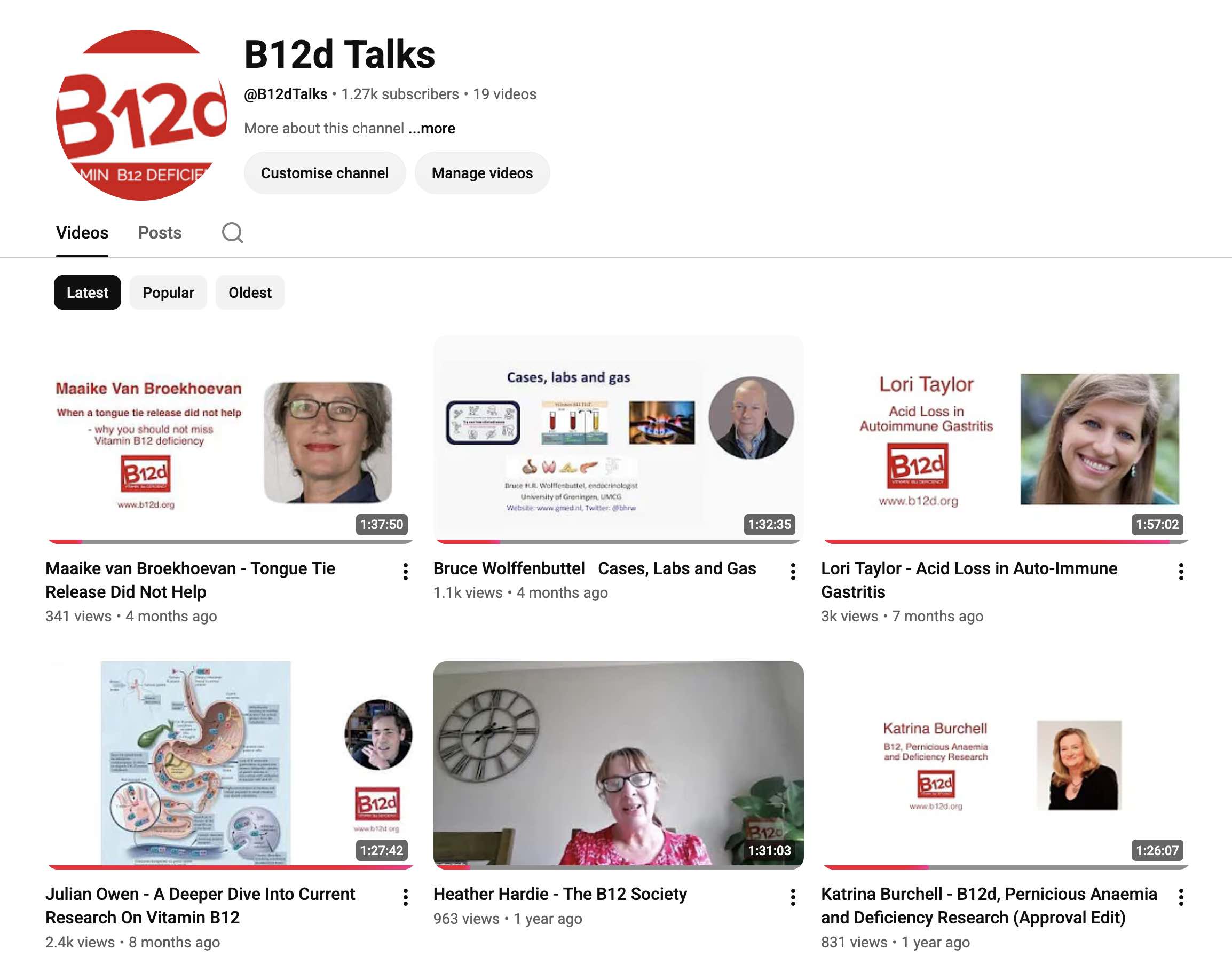
YouTube Channel
You can find past talks and webinars on our YouTube channel. Because of the permissions needed, and the editing requirements to clean up sound and interweave slides, sometimes there is a delay.
Visit our YouTube channel here: www.youtube.com/@B12dTalks
Website: www.B12d.org
Our website is still growing and we’re developing the priorities for what we want to be front and centre. With the sheer amount of information, it wasn’t always easy to find things.
If your favourite page is missing, please let us know and we’ll work on updating to a current version.
The website tells a story, so when you’re feeling brain fog you can still follow it. It’s like when you’re reading Dr. Chandy’s book, we suggest you connect with the people (by reading the case studies) before diving into the main text. We are taking a similar approach with the website. You will be able to explore symptoms and personal experiences first. Then, you can delve deeper into the information if you choose.
Dr. Chandy’s book is available on the website (for FREE) in several formats:
- Individual chapters
- A complete download
To subscribe to this newsletter, please email me with the subject line “NEWSLETTER SIGNUP“.
B12d Symptom Checker
You can download the protocol for diagnosis and treatment, the symptom checker, and Dr. Chandy’s book here:
- Protocol for diagnosis and treatment: http://www.b12d.org/protocoltreatment
- Symptom checker: https://b12d.org/symptoms–checker–print/
- Chandy’s book: www.b12d.org/book The online Symptoms Checker is BACK!
You can enter your symptoms online and get an immediate calculation of your likelihood for B12 deficiency. This is not a medical test, but it does give you the evidence to go to your doctor and say you want to start treatment (and you can print out a copy of your results marked with the date and time). Try it out on https://b12d.org/symptoms–checker/ and tell us what you think!
This currently doesn’t store anything. If you want to keep your history, check your symptoms every day (or every week) and print a copy (to PDF if you prefer). We’re still exploring how to keep your symptoms information secure so as to save it.
NICE Guidelines NG239 – Vitamin B12 deficiency in over 16s:diagnosis and management
These new (March 2023) guidelines are a major milestone for the diagnosis and treatment of B12 deficiency. NICE is the National Institute for Health and Care Excellence (I know it should be NIHCE but it isn’t) and is the top authority in England for issuing guidelines. The Scottish body (SIGN) also uses NICE guidelines where they haven’t issued a separate one.
There are a number of summaries of what NG239 means by eminent doctors, this one is quite a popular one https://www.pulsetoday.co.uk/clinical–feature/clinical–areas/gastroenterologyobesity/what–gps–need–to–know–about–nices–vitamin–b12–deficiency–guidance/ .
In brief:
- The NICE guidelines highlight that B12 deficiency is widespread and can come about from a number of different factors, and the cause (in broad terms) is important in determining the treatment
- Symptoms are a key diagnosis tool. Blood tests have significant margin for interpretation, but the general principle is “if in doubt, start treatment”
- B12 injections IM should be the default (the person is unable to absorb or process B12) unless it is obvious that the person has too little B12 in their diet, in which case either advice on diet or supplements are appropriate.
Coffee Mornings
Before the COVID-19 pandemic, B12d held in-person coffee mornings. These gatherings were enjoyable and provided support for people who felt isolated.
Dr. Chandy, a GP in the North East, held the coffee mornings in Peterlee. They alternated between Peterlee town centre and Horden.
We are pleased to announce that the coffee mornings are going again!
Peterlee Coffee Morning
- When: The 4th Monday of each month (except Bank Holidays) at 10:00 AM
- Where: Poppy Dene Lemon Tree Café (SR8 5AS)
- Host: Susan Peacock, Chair of B12d
We are also planning coffee mornings in Sunderland, Dorset and some other parts of the country.
Would you like to start a coffee morning in your area?
Your Emails
Dr. Chandy was a dedicated doctor who served the community of Horden for over 40 years. He founded this charity and continued to help people with Vitamin B12 deficiency long after he retired. He was known for personally answering emails and phone calls to assist people.
Sadly, Dr. Chandy passed away in December 2023. However, expert patients will continue to answer your emails. Please feel free to send your questions to notifications@b12d.org .
Social Media Groups – Our WhatsApp Group
We are a community. In addition to our in-person gatherings, we also have online communities.
We have a WhatsApp, B12d.org Charity Support Group.
Join our new WhatsApp group here: https://chat.whatsapp.com/KaJ917o7e7n1ycXWT1pAWn
There are also three Facebook groups connected to B12 deficiency:
- B12 Deficiency – functional, neurological and autoimmune
- B12 Support Group
- International B12 Deficiency Support Group
Please remember not to share private medical details on Facebook or WhatsApp. These communities are primarily for support, not medical advice. There are NHS and private doctors and functional medicine practitioners in each group, but they act on their own experience. Note that lots of experts by experience (fellow sufferers) who can give you their own experience. Everyone is different and responds in our own unique ways, so what works for one person might not work for you.
Where Can I Get B12 Injections in the UK?
We no longer supply B12 for injection.
It is becoming more difficult to obtain B12 for injection. Some people have had success with suppliers in Germany (especially when using PayPal and ensuring the delivery address matches the PayPal address). Note if one supplier doesn’t have stock, it’s worth checking others, because different ones have stock at different times. There are a number of suppliers – check the Social Media groups especially WhatsApp.
Another option in the UK (which also ships to the USA) is Oxford Biosciences. They offer a dry powder that needs to be mixed with saline. It works the same as pre-mixed injections. Oxford Biosciences can ship the powder worldwide. You can call them to request sterile saline, if they have it available.
For oral B12, there are many sources, including Amazon and Holland & Barrett. We recommend considering methylcobalamin and adenosylcobalamin (often sold as dibencozide). However, many people do well with cyanocobalamin.
If you want an assessment and injections, let us know as there are a few clinics able to offer this, for a fee of course since this is not funded by NHS. One of these is https://www.abhealthhub.com/, run by one of our own Trustees Annie Barr MBE. We don’t get anything from you using her hubs, but if we’re going to tell you where to find help, then it makes sense to recommend someone we know so well.
Donations
If you would like to help the charity with a donation or a standing order, please make it to
“B12d” at TSB Bank 77-29-07 18833068, or use the link https://www.paypal.com/donate/?hosted_button_id=XFHFAQKKAU5NQ. We’re continuing to develop our website and creating more materials to inform doctors and patients, and we still send out books via the Doctor Book Scheme (see below). Your donations have enabled us to produce the videos from our guest speakers, and we want to build the symptoms checker. This would mean that your queries go into a proper process where we can check your recorded symptoms in the symptom checker and your previous questions and answers and more easily send information sheets.
Doctor Book Scheme
UK-based clinicians can request a copy of the book “Vitamin B12 Deficiency in Clinical Practice” by Dr Chandy and myself in physical (printed) form by sending an email to notifications@b12d.org subject line BOOK, including your POSTAL ADDRESS (surprising how many people miss this off – I can’t send you a copy if I don’t know where to send it!), name, and a number in case Amazon need to contact you about the delivery.
You can download an electronic copy of the book from www.b12d.org/book, either in individual chapters or the whole book. This is free of charge for anybody and everybody.
You can purchase a printed physical copy from Amazon (all their worldwide sites). Black and white version https://www.amazon.co.uk/Vitamin–B12–deficiency–clinicalpractice/dp/1097697452/ at around £6.30, colour version
https://www.amazon.co.uk/Vitamin–Deficiency–Clinical–Practice–colour/dp/109678291X/ for £24. When reading the book, start by reading the case studies and get to know the people before reading the text. It’s designed as a medical textbook to be a little heavy, even for an expert patient.
We don’t make any profit on the book (that’s why we don’t know the exact price – it depends what it costs Amazon to print on that day), so feel free to download instead of buying a printed version. It is a huge book, so if you prefer a paper copy, it’s likely to be cheaper to buy from Amazon than print on your home or work printer.
Sincerely
Hugo, Carrie, and the Trustees
B12 Deficiency Support Group (registered as charity 1146432)
Horden, Co Durham, UK http://www.b12d.org
Email our expert patients to ask about your specific symptoms notifications@b12d.net
Data Privacy and your right to receive or not receive newsletters
You are receiving this newsletter because you opted to receive our monthly newsletter. You can change this at any time: click this link to send an email to me. Or click here to unsubscribe.
You can also close your membership on our website. Please be aware that this will mean you won’t be able to check your symptoms.
If your friend is receiving this email and you are registered but aren’t receiving it, please click sign up on the website.
We use your name, address, and email to send you this email (if you have opted in to receive the email). We may also use symptom data anonymously to understand more about B12 and its progression.
We may, at some point in the future, develop a complete CRM which will use your data to provide more comprehensive support. We will keep you informed as this progresses.